Help restaurants grow with commission-free online ordering while earning predictable monthly revenue through your own branded platform.
Earn predictable monthly income from every active restaurant you bring onboard. As your client base grows, so does your recurring revenue.
Offer a fully branded solution that reflects your business—not ours. Build stronger client relationships under your own name and identity.
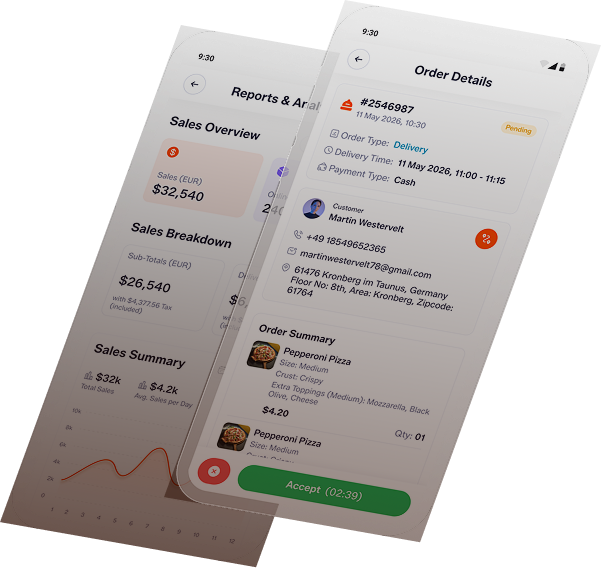
Manage every restaurant, subscription, and service from one powerful reseller dashboard designed to simplify your daily operations.
Start with just a few restaurants and scale to hundreds as your business grows—all from the same platform without changing the way you work.
Your revenue from subscription:
Starter - $49.00, Pro - $99.00, Business - $199.00
*You can charge more than actual pricing from your restaurant clients based on your business goals & location.
Subscription plan
Estimated monthly revenue
Estimated yearly revenue
Complete your partner application & apply for it.
Our team reviews your application & helps you get started.
Configure your logo, domain, and reseller settings.
Launch restaurants, earn recurring revenue, & grow your business.
| Features | POSPanda | Typical white-label |
|---|---|---|
| Multi-tenant dashboard | ||
| Your own branding | ||
| Wholesale pricing | ||
| Restaurant ordering website | ||
| QR Table Ordering | ||
| Table Reservation | ||
| Marketing Tools | ||
| Dedicated partner support |
Everything you need to know before becoming a POSPanda partner.
Still have questions or need help setting up? Our support team is always ready to help you set up, learn, and grow with POSPanda.
Contact UsSteaming is widely considered one of the best cooking methods for preserving nutrients, especially water-soluble vitamins like vitamin C and B vitamins, since the vegetables aren't submerged in water where nutrients can leach out. Roasting and stir-frying at moderate temperatures are also good options, while boiling for extended periods tends to cause the greatest nutrient loss. Cutting vegetables into larger pieces before cooking and minimizing cook time also helps retain more of their nutritional value.
Gently press the avocado with your thumb near the stem — if it yields slightly to firm pressure, it's ripe and ready to eat. You can also check the small stem cap at the top; if it comes off easily and reveals green underneath, the avocado is ripe, but if it reveals brown, it may be overripe. A hard avocado that doesn't give at all is still unripe and needs a few more days at room temperature.
No, it's generally not safe. Perishable foods left at room temperature for more than 2 hours enter what's known as the "danger zone" (between 4°C and 60°C / 40°F and 140°F), where bacteria multiply rapidly. If the room is particularly warm, above 32°C (90°F), this window shrinks to just 1 hour. To stay safe, refrigerate leftovers promptly and when in doubt, throw it out.
Yes, in many recipes you can substitute butter with oil, though the ratio and result may vary. As a general rule, use about 3/4 the amount of oil as the butter called for, since oil is 100% fat while butter contains some water. Keep in mind that oil-based baked goods tend to be denser and more moist, while butter contributes more to flavor and a flakier texture, so the swap works best in cakes and muffins rather than delicate pastries like croissants.
A "best before" date indicates when a product is expected to be at its peak quality — flavor, texture, and freshness — but it's often still safe to consume after this date if stored properly. An "expiry" or "use by" date, on the other hand, is a safety indicator, especially common on perishable items like dairy, meat, and ready-to-eat meals, and food should not be consumed past this date due to potential health risks.
Most cooked leftovers stay safe to eat for 3 to 4 days when stored in an airtight container in the refrigerator at or below 4°C (40°F). After that, the risk of bacterial growth increases significantly, even if the food still looks and smells fine. If you don't think you'll finish leftovers within that window, it's best to freeze them instead, where they can typically last for 2 to 3 months without a major drop in quality. Always reheat leftovers to an internal temperature of at least 74°C (165°F) before eating.