GloriaFood vs PosPanda: What Restaurant Owners Should Know Before Their Next Move
22 September, 20265
PosPanda vs GloriaFood: What Restaurant Owners Should Know Before Their Next Move
By Rabiul Islam, Founder of PosPanda | Researched September 20, 2026
An online ordering system becomes part of a restaurant’s routine surprisingly quickly. Customers bookmark the menu. Staff learn the notification sound. The ordering link ends up on Google, Instagram, takeaway packaging and the QR code beside the till.
Replacing it means changing a small but important part of how the business earns its money.
That is why the comparison between PosPanda and GloriaFood deserves more than a feature checklist. GloriaFood’s discontinuation makes this a business continuity decision, particularly for restaurants that already depend on it.
I’m PosPanda’s founder, so my interest is clear. This comparison draws on published product information and practical restaurant workflows; it is not a claim that I have independently tested both platforms under identical service conditions.
The shutdown is confirmed. The published dates need clarification.
Oracle says GloriaFood is being discontinued and is no longer accepting new signups. However, its public food-and-beverage page gives March 31, 2027 as the end-of-service date, while GloriaFood’s homepage says April 30, 2027. Both describe continued support for existing customers during the transition.Oracle’s announcement,GloriaFood’s service notice
Restaurant owners should request written confirmation of the deadline for their account. For planning purposes, working toward the earlier date leaves more room for problems than assuming the later one.
PosPanda is publicly offering restaurant registration and actively recruiting partners. That makes it an option to evaluate now. Its public pages do not establish a verified customer-growth rate, so claims about rapid adoption would go beyond the available evidence.
For an existing GloriaFood customer, the immediate job is to protect the ordering channel while preparing a replacement.
What each platform brings to the restaurant
GloriaFood’s proposition was straightforward: add ordering to a restaurant’s digital presence without paying commission on every sale. Its published offering includes pickup, delivery, scheduled orders, QR ordering, reservations, and an order-taking app. That combination helps explain its appeal to independent restaurants seeking a manageable starting point.
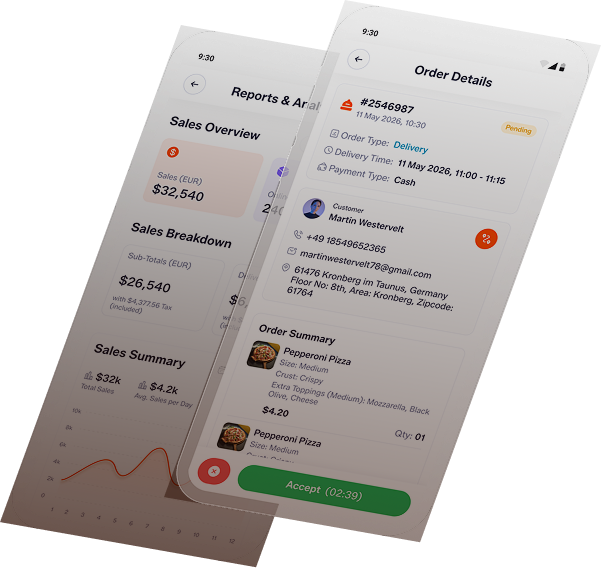
PosPanda presents a broader restaurant workspace around branded ordering, reservations, an administrative dashboard, an order-taking app, POS and delivery management. Its potential benefit is having related tasks within one product family. Restaurants should still verify which modules their chosen subscription actually includes.
The operational question is simple: when someone orders a pizza with extra toppings for collection at 7:15, where does that information appear, who accepts it, and what reaches the kitchen?
A convincing demonstration should answer that without skipping the awkward parts.
Free plans and the cost of getting started
GloriaFood does advertise a free service plan. Its pricing page lists unlimited orders without a monthly fee or per-order commission. The current restriction is that Oracle has closed new signups, not that the free offering never existed.
Its published paid services include online payments at US$29 per month and advanced promotional marketing at US$19 per month. Payment-provider charges and other services require separate consideration.GloriaFood pricing
The free-plan description does not clearly establish the reset period for its 100-order allowance. Confirm that before planning around it.PosPanda pricing
A café testing online pickup has different needs from a busy takeaway already receiving hundreds of digital orders. The café should examine entry costs and setup effort. The takeaway should examine capacity, payment handling and staff workload.
For a restaurant group, the quoted subscription is only the beginning. Ask how branches, staff access, menu differences and reporting affect the total.
Both have a website story
GloriaFood should not be described as having no storefront. Its website generator creates restaurant websites with integrated ordering and allows changes to sections, imagery, and colours. Its editor also supports menu setup.
PosPanda promotes its own branded restaurant ordering website.PosPanda
The useful comparison is how much control the restaurant gets and how easily staff can maintain it.
Can you update a holiday opening time without waiting for a developer? Can a customer find delivery information before filling a basket? Does the mobile layout handle a long menu with modifiers comfortably?
Ask to make those changes during the demo. A polished sample restaurant tells you less than your own menu does.
Branded apps and PWAs solve different problems
GloriaFood lists branded mobile apps as premium features. Its currently published pricing page does not provide a clear standalone app price, so older figures should not be treated as a current quote.GloriaFood pricing
PosPanda’s Business tier lists a mobile app, but the site navigation still marks the branded app “Coming Soon.” Inclusion in a package therefore needs to be distinguished from availability today. Get the release status, supported operating systems, and publishing responsibilities confirmed.
PosPanda also advertises a PWA: an installable web experience that does not require an app-store download. I did not find equivalent PWA documentation in the GloriaFood materials reviewed. That is a documentation distinction, rather than proof that no such capability exists anywhere in its offering.PosPanda’s PWA description
For customers, the practical benefit is convenient repeat access. Installation alone does not establish support for offline checkout, notifications, or every native-app feature. Those behaviours need testing on the devices your customers use.
Loyalty deserves a closer look than a tick in a comparison table
GloriaFood has tools for encouraging repeat purchases. Its marketing documentation describes offers based on previous order counts, spending and purchase history, alongside automated email campaigns. Calling that “no loyalty functionality” would overlook meaningful retention features.
PosPanda’s site names a loyalty program but currently labels it “Coming Soon.” It should therefore be treated as an upcoming capability until release is confirmed.
A points balance, a fifth-order reward and a reactivation discount are different mechanisms. Restaurants should decide which behaviour they want to encourage before comparing implementations.
For example, a weekday lunch business might benefit more from a well-timed repeat-order offer than a complicated rewards scheme. Whatever the mechanism, staff need to understand how refunds, cancellations and redemptions affect it.
Ease of use shows up during service
Neither a clean dashboard nor a long feature list proves that software is easy to operate.
Ask a member of the restaurant team to perform a short sequence without coaching:
Mark a dish unavailable.
Change its available modifiers.
Pause delivery while keeping pickup open.
Accept a scheduled order.
Find and resolve a cancelled transaction.
These are evaluation tasks, not reported test results for either platform.
GloriaFood’s widget-based approach can suit a restaurant that already has a website and wants a familiar ordering layer. Its configurable generated website offers another route. PosPanda’s proposition may appeal to owners who want to assess ordering alongside more of their operational tools.
More functions can reduce the number of separate systems a business uses. They can also introduce more configuration. The right balance depends on who will maintain the setup after launch.
Integrations need names, versions, and a live demonstration
GloriaFood publishes order and menu APIs and lists integration partners covering POS, delivery and other services. Its order API documentation describes passing order details after acceptance in the order-taking app. That timing matters when designing the kitchen workflow.GloriaFood API and integration directory
The PosPanda pages reviewed do not establish compatibility with every external POS, delivery marketplace, or payment terminal. A built-in POS offering should not be mistaken for a ready-made connector to an existing system.
Bring an exact equipment and software list to the discussion. “We use a thermal printer” is insufficient; the model, connection method, and operating device can determine what works.
Then follow one order through payment, printing, kitchen handling, and reporting. Agree separately on anything that needs development.
Support and reliability require evidence
GloriaFood’s published notice commits to supporting existing customers through its stated transition period. That is helpful for planning, although it does not resolve the conflicting dates.
For either provider, ask who handles a failed-order incident during your busiest service. Get support hours, escalation contacts, backup procedures and recovery expectations in writing.
There is no independent, like-for-like uptime comparison presented here. It would be misleading to declare one platform more reliable without that evidence.
For a restaurant, reliability includes people as well as servers. A technically available system is still a problem if nobody can explain why an order failed.
Who should consider each option?
GloriaFood’s strengths include its free core offering, established ordering workflow, website tools, and documented integrations. Its decisive limitation is the announced discontinuation. Existing users may continue operating during the transition, but further investment should be weighed against the work needed to move.
PosPanda is worth evaluating for restaurants seeking a replacement direct-ordering channel, businesses reviewing their website and operational setup together, and agencies exploring a branded restaurant offering. Its partner program describes white-label branding, onboarding resources, and a reseller dashboard.PosPanda partner program
Its limitations deserve equal attention: some advertised capabilities remain forthcoming, plan boundaries need checking, and integration or reliability claims should be demonstrated rather than assumed.
A restaurant with a complex existing POS environment should make compatibility the first buying condition. A smaller operator may reasonably prioritise straightforward setup and affordable ongoing operation.
Migration support should produce a written plan
Switching platforms involves more than copying dish names.
For a move to PosPanda, request a migration assessment covering menu structure, modifiers, prices, images, opening hours, delivery zones, payments, reservations and customer records. Agree on what the team will help transfer, what must be rebuilt, the cost and the launch responsibilities. Dedicated onboarding should not be interpreted as a guarantee that every historical record can be imported.
A workable transition has five stages:
Inventory the existing setup. Include ordering links, QR codes, integrations, and upcoming bookings.
Preserve accessible records. Establish what can be exported and how it can be used in the replacement.
Configure and test privately. Check real menu combinations, payment outcomes and fulfilment rules.
Choose a controlled launch window. Avoid changing the ordering channel immediately before peak service.
Update customer entry points. Website buttons, social profiles, printed materials and saved links all need attention.
Historical orders, customer passwords, and saved payment credentials should never be assumed transferable. Establish a fallback procedure before switching off anything that still works.
For GloriaFood users, the strongest reason to evaluate PosPanda is the opportunity to prepare a replacement while there is still time to test it properly.
Bring your menu, your current costs, and the parts of service that cause the most friction. Ask to see those exact situations handled.